Microsoft Dynamics GP "12" Web Client Architecture Series – Mariano


Mariano walks us thru’ Microsoft Dynamics GP “12” Web Client Architecture in his new series of posts.

Two posts are already up and there for us to read. One (which is also the final one) is shortly coming. Needless to say, all 3 are very informative.

Those who have not visited these posts, don’t miss it.

VAIDY

Packt Publishing Celebrates Dynamics Month – May 2011


Packt Publishing, the publishers who published some of the famous books such as Microsoft Dynamics GP 2010 Cookbook (authored by Mark Polino) and Microsoft Dynamics GP 2010 Implementation (authored by Victoria Yudin), has now come with a great idea: Celebrate May 2011 as Dynamics Month.

This comes after they have added one more Dynamics GP book, which is Microsoft Dynamics GP 2010 Reporting.

And of course, it’s not just a celebration. It’s about some really interesting exclusive offers when you buy these books. Trust me, there are some great books out there for your grabbing. Those who have not availed previous opportunities in reading these books that are treasured and revered by many, this IS time. Go for it.

VAIDY

Getting Month Numbers between two dates in T-SQL


I literally had to spend around an hour to crack this code, with some little help from my best geek friend, GOOGLE, of course.

Issue is this: I wanted to get Month in Numbers (Jan = 1, Feb = 2, etc.) that exist between two dates. For instance, if my date range is 1-Jan-2011 to 31-Mar-2011, then I should find and retrieve the months Jan, Feb and Mar as 1, 2 and 3 respectively.

After much much toiling and reading some stuff online, the following is what I got for myself:

—–

;WITH Numbers (Number) AS
(SELECT ROW_NUMBER() OVER (ORDER BY OBJECT_ID) FROM
sys.all_objects)
SELECT MONTH(DATEADD(MONTH, Number – 1, ‘2011-01-01’)) Month_Number
FROM Numbers
WHERE Number – 1 <= DATEDIFF(MONTH, ‘2011-01-01’, ‘2011-03-31’)

—–

IMPORTANT: Make sure that you have more than 12 records in sys.all_objects table, which by default SHOULD have.

I hope this code piece is useful for some who have got similar requirement.

VAIDY

What is Days Sales Outstanding (DSO) and how it is calculated?


The concept that I learned in past 2 days is this: Days Sales Outstanding (DSO) and the way you calculate it.

Joshua Burnett has posted an article on this way back in March 2009. Read it here: The DSO Calculation (Days Sales Outstanding).

It’s quite simple and yet very deep in concept. I simply loved to read and learn. I am sure it would be useful to some people out there, trying to understand what DSO is all about.

VAIDY

T-SQL "UNION" Vs "TABLE variable"


Very recently I learned this. And what a change it has made to all of my SQL based projects! I am sure people who are hardcore SQL programmers would already know this. Thought of sharing this for those who would want to know something interesting.

I had a SQL Stored Procedure that is about to retrieve records of a same table from two different databases. The usual approach was something like below:

SELECT [column_name_1], [column_name_2], [column_name_3], …
FROM [db_name_1]..[table_name]

UNION

SELECT [column_name_1], [column_name_2], [column_name_3], …
FROM [db_name_2]..[table_name]

This was working till these tables contained records less than 30000 rows. And it started taking significantly unacceptable time (like 10-15 seconds). I then thought of creating a temporary table and dump records from one DB then from other. There is a potential issue in that, in the form MULTI-USER environment. When two different users invoke this stored procedure at the same time, this temporary table must cater for both. I was not really sure about how I can address this.

Then came this idea of using TABLE VARIABLE. It’s like a Structure in C++. This is how I modified my stored procedure:

DECLARE @TABLE_NAME TABLE
(
Column_1 DATATYPE,
Column_2 DATATYPE,

)

INSERT INTO @TABLE_NAME (Column_1, Column_2, …)
SELECT [column_name_1], [column_name_2], …
FROM [db_name_1]..[table_name]

INSERT INTO @TABLE_NAME (Column_1, Column_2, …)
SELECT [column_name_1], [column_name_2], …
FROM [db_name_2]..[table_name]

SELECT Column_1, Column_2, …
FROM @TABLE_NAME

After this, the program started taking around 2-5 seconds with more than 50000 records to handle. Not to forget, this program contained several grouping and calculations.

I don’t have to worry about delay and also TEMP TABLE issues that are potentially disastrous. I am still not sure how this is handled in terms of memory allocation. What happens after this program completes it’s process, is also a factor that I am yet to figure out.

But, so far, I have found this as one of the best methods in recent times.

VAIDY

Dexterity "Reject Script" Command – David


David’s recent post on reject script command in Dexterity has got some really crucial information about it’s scope and usage.

After 7+ years of Dexterity experience, I did learn something which I had not in the past. MUST READ for any Dex developer.

VAIDY

Microsoft Dynamics GP2010 R2 – SSRS BI maxRequestLength Error


Another one, luckily Mohammad R. Daoud has got an answer to this issue.

Once GP2010 R2 installation is over and GP Utilities start configuring system, almost the last setup is SRS Reports Deployment wizard. It’s a welcome change from previous versions, as this one is more explanatory and clear.

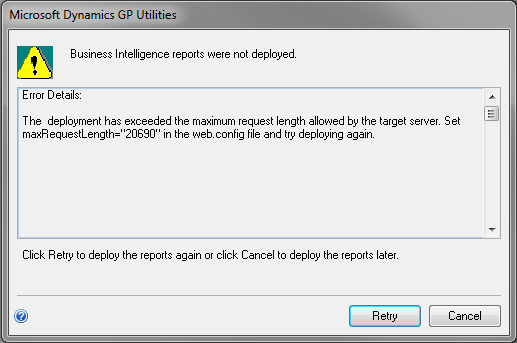
Once it starts deploying reports, the following error message is thrown:

The message is self-explanatory on what needs to be done to get rid of this message. To understand how to find WEB.CONFIG file, read Mohammad R. Daoud’s post; Dynamics GP 2010 R2 Business Intelligence Installation Error maxRequestLength.
Thanks Daoud. It was really helpful.
VAIDY

Microsoft Dynamics GP 2010 R2 – SRS Reports Deployment Error


Everyone knows that GP2010 R2 got released well before it’s announced date (1st May 2011). And I was no exception in starting off with it.

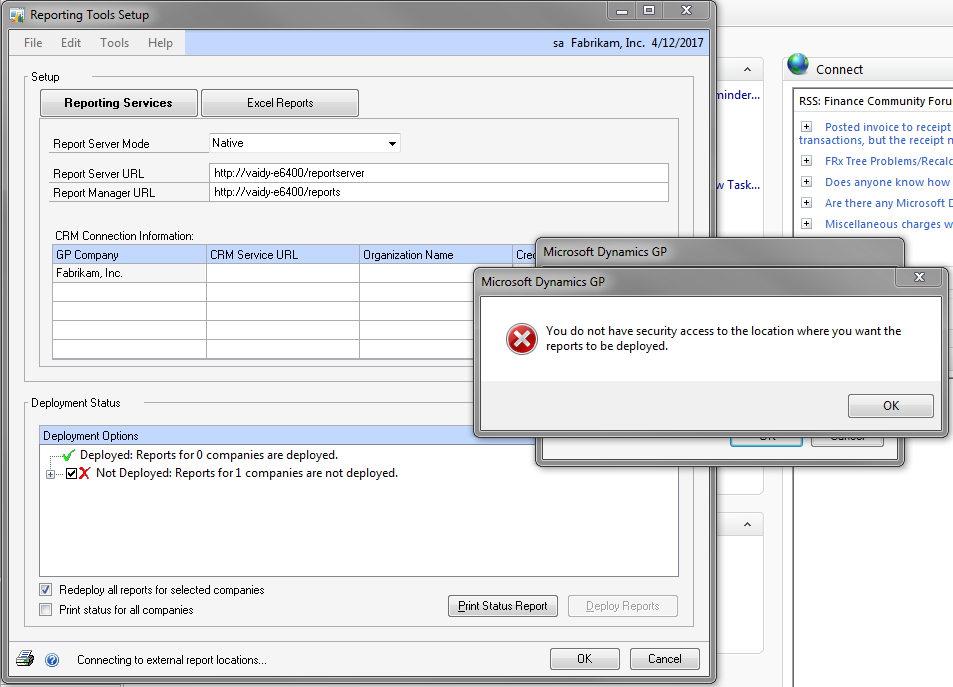
I installed GP 2010 R2 on my laptop and it went thru’ merrily. And started off with deploying SSRS and Excel Reports. Below is the error message I am getting:

Reason: I am running SQL Server 2008 R2 Express. For some reason, SRS deployment do not recognize SQL Server Express editions and it requires either Standard or Enterprise.
So people, those who would wish to deploy SRS on SQL Server 2008 R2 Express, please do not.
VAIDY

Microsoft Dynamics GP Web Client – David shares more information


Microsoft Dynamics GP Web Client – Teaser Articles


Matt Landis shows us a great glimpse of Microsoft Dynamics GP Web Client. Awesome to see GP’s future.

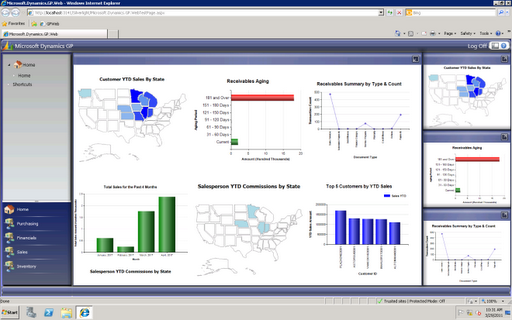
Following image is from Mariano’s blog article, Microsoft Dynamics Convergence Atlanta 2011: Day 2 Morning:

The web client seems to be getting developed using Microsoft Silverlight. There are much more news and announcements to come from Convergence 2011.

Trust me, it’s gonna be fun in an year from now with Microsoft Dynamics GP.

VAIDY