Analytical Accounting YE Close – AAG30000 Primary Key Violation Error


UPDATE (06/14/2011): A comment from Kumar clears this entire thing. There is a KB article which explains how to update Intercompany ID on a Test Company once we restore Live Data. Link to that KB article: Set up a test company that has a copy of live company data.

Our Finance Team and I decided to first do perform YE Close on our test company first before we make it to Live, to anticipate any possible issues and also learn this entire process as this our first YE close in GP2010.

You must by now anticipated what I had done to simulate Live Company. YES, I created a Test Company on same SQL Server (Mark, trust me, your post came after this exercise) and restored live company data on to Test Company.

This we normally do for any transaction level exercise that users would want to perform for their own sake.

The process started and after a good enough time of about 5 hours, it threw an error message, which said roughly Primary Key violation of key PKAAG30000 on table AAG30000.

Upon digging more and keeping a SQL Server profiler, I met this silly yet critical reason: AA was trying to create an entry on table AAG30000 in Live Company database. Why? I have no clue why it would ever happen.

My only guess is that every Journal Entry in GL table will have Live Company Database ID (such as TWO that denotes sample company). AA might have thought that this one is an Intercompany transaction and it requires to create an AA entry in Live Company for that portion of JRN that was processed in Test Company. The only field in AAG30000 that’s considered as Primary Key is aaGLHdrID. My live company would have gone past the next aaGLHdrID which is in Test Company (a back dated restoration) by the time I ran YE close on my Test Company.

I am yet to prove my own theory above, but I strongly doubt so.

Upon suspicion, I decided to create a TEST SERVER (Mark, your post had come exactly at that point of time). I just believe Mark Polino’s Weekly Dynamics article was so timely and I couldn’t agree for more.

After configuring a Test Server environment, I restored DYNAMICS and Company DB, pointed my GP to this test server and ran YE close as if I was running it on my production server.

Good god, YE Close got over without any AA error. I then had no other option than to believe that Test Company with Live Data do not augur well for exercises such as YE close and is in fact quite risky.

Addendum: With GP 12 Multi-Tenant architecture, we don’t have to worry about this, as we can easily setup a TEST SERVER along with LIVE SERVER in the same physical server.

VAIDY

Account Segments Vs. Analytical Accounting – My Thoughts


This post from Mohammed R. Daoud sums it all about Account Segments Vs. Analytical Accounting.

I just wanted to share my thoughts:

Account Segments are simply real. You are going to have separate accounts for specific entity and that means you must be setting these accounts up on several other places in GP other than only Posting Accounts setup. For instance, if you are going to have accounts for each employees of your organization and you track expenses on them, then you got to have each account setup against each employee explicitly and setup GP such that it takes accounts from employee directly instead of Posting Accounts.

Analytical Accounting is purely logical. You don’t really have separate account for each entity that you wish to. Setting up AA dimensions and codes are one time.

Actual complexity lies in assigning AA codes on a particular transaction. Worst case, if you have an apportionment across different AA codes, you have manually apportion it in Analytical Accounting Transaction Entry form. Data Entry is very complex at times with AA. Without proper AA setup, your data will logically scattered and any analysis on this data would be a menace for you to understand.

You can minimize the data entry time by using Analytical Accounting ALIAS, but that again depends on case to case basis. You cannot always depend on AA ALIAS for all kinds of transactions.

Simply speaking, AA considerably reduces your COA but let you toil at times entering apportionment within a transaction. You gain on one side, you have to experience some pain on the other side.

VAIDY

Microsoft Dynamics GP 12: Multi-Tenant Architecture


Though it’s too late for me to write about this post by Mariano, it’s always Better Late Than Never for me.

I am not going to discuss this post here. I am just creating a pointer to this article here, since it’s worth to go to Mariano’s site and read it there.

The post, Microsoft Dynamics GP “12” Named System Database Architecture, explains us what this new feature is and how it is going to be designed. Benefits and challenges are discussed as well.

Bottomline: With this new architecture, customers and consultants are going to be delighted. GP 12 is going to be just terrific. There are challenges as pointed out in the last paragraph but will be met with ease by those dependable brains.

Thank you so much Mariano for sharing this first hand information.

VAIDY

Complete list of Microsoft Dynamics GP 2010 R2 SSRS Reports


Inside Microsoft Dynamics GP has listed out all SSRS reports for Microsoft Dynamics GP 2010 R2.

The list categorizes reports by module and indicates whether it’s a normal report or KPI based report. This would be the best document to make us aware of and convince our customers that GP does have such expansive list of standard reports and KPIs.

VAIDY

Microsoft KB Articles – Is it really confidential?


I am well aware this post may kick up some controversies. But I honestly do not mind facing that.

Recently one of my contacts asked me about a GP process and asked my help in getting any KB articles related to that process. I said I would share the KB article number with him but since Microsoft says that it is all *confidential*, I cannot distribute the article directly or publish it directly on my website. I also mentioned that he could instead refer to that KB article number and look it up from Microsoft PartnerSource / CustomerSource. After all, I was under the impression that he’s also a Consultant and is working with a Partner, so ideally he has got access to PartnerSource.

After a week, I was quite shocked to know that he later *downloaded* the same KB article from some other website (I do not want to name this website here, as it is also a known Microsoft Dynamics Partner) as a PDF document. And he criticized me for giving him a lame reason for not sharing the article myself. Worst thing, he even accused me of being selfish in keeping information only with me. OK, that’s quite understandable from his side. What I don’t understand now is the term CONFIDENTIAL on all these KB articles.

Microsoft is keep these articles with a confidentiality tag and has given access ONLY via CustomerSource or PartnerSource. But in reality there are many people out there who clearly violates this *confidentiality* part and has published these articles open.

It’s quite simple. I just don’t want to look dumb in front of people when I say “These KB articles are confidential and are NOT supposedly to be distributed openly”. Well I am frankly serious. You feel like you are the most dumbest guy in this world by saying that. Come on, you have these articles openly sprayed out there on several websites (some of them are genuine Microsoft Dynamics Partners) and all you gotta do is to search and download it.

That brings on my mind several questions for Microsoft:

1. What’s the scope of confidentiality for all these KB articles?
2. On what basis this *confidentiality* is defined and when it is considered violated?
3. What is the real point in keeping these articles as confidential, if I can download these articles from anywhere anytime anyhow?
4. Why don’t you just take that *confidential* tag out and keep it open for all, irrespective of whether they have CustomerSource / PartnerSource access?

VAIDY

Apture Highlights – A Cool New way of Searching within a Website


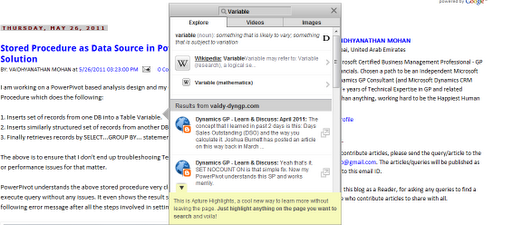
A cool new addition to my website. APTURE HIGHLIGHTS. It works like this:

Just select any word on my blog posts and automatically a small icon that says “LEARN MORE” would appear. Just highlighting on that icon would do wonders as shown below:

Quite an amazing way of searching about something without leaving the actual website. I would recommend this to all our fellow bloggers to try this and get benefitted.
I am so impressed with this and it’s going to be fun to all my blog readers.
VAIDY