Over the past year, I got the privilege of being a reviewer of books written by Dynamics GP Experts/MVPs. I wished writing about these books once they got published, but it never happened till now. Here we go.
To begin with, this post is my views of an all important book:
Microsoft Dynamics GP 2013 Implementation
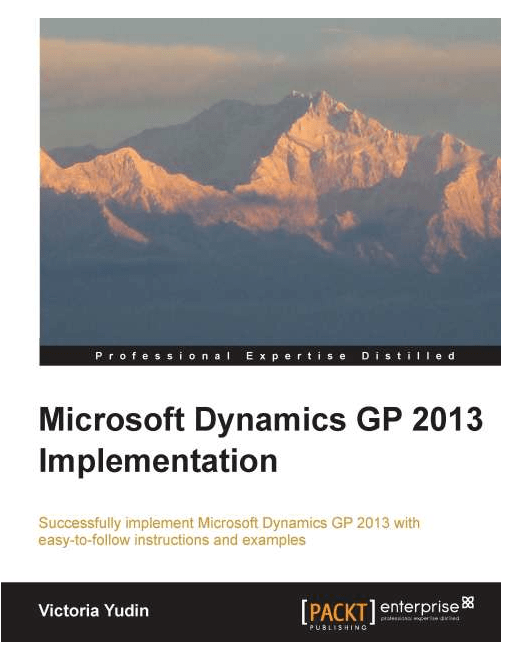
This book is written by Victoria Yudin, founder of Flexible Solutions, a GP expert and an MVP (an award that she holds on to for past 9 consecutive years). She’s been an ultimate inspiration to entire GP community and it simply makes sense to buy this book the moment you realise that it’s been written by her.
In addition to that, what makes this book so valuable is the content without doubt and the way implementation concepts are structured and explained. Following is the way the entire book is structured:
- Chapter 1: Application Structure & Licensing
- Chapter 2: Planning – Business Requirements
- Chapter 3: Planning – Dynamics GP System
- Chapter 4: Planning – Infrastructure
- Chapter 5: Installation of SQL Server, Dynamics GP and Integration Manager
- Chapter 6: System and Company Setup
- Chapter 7: Module Setup – General Ledger, Bank Reconciliation, Payables and Receivables
- Chapter 8: Module Setup – Inventory, SOP and POP
- Chapter 9: Populating Initial Data
- Chapter 10: Training, Tools and Next Steps
- Appendix: General Ledger Account Categories
Chapter 1 discusses in detail about application structure and licensing of GP. A lot has been changed with GP 2013 in terms of licensing. Microsoft has moved some of the important modules to respective original developers. You may not know that from this book, but you would completely understand how new Perpetual Licensing now work and how to plan your requirements (with regards to modules) in advance.
Chapters 2 – 4 discusses in detail about how to PLAN your implementation; from visualising your requirements to the infrastructure that you would require.
Chapter 5 discuss in detail about how to install all applications required for your ERP environment, from the database that is SQL Server till the tool to integrate your initial data, that is Integration Manager.
By the time we finish reading first 5 chapters, purpose of this entire book is almost realised. 3 chapters are dedicated only to discuss Planning your implementation and that, in my opinion, is what matters in any implementation. You know your requirements very well and you have a finalised plan, you are 75% done with your implementation already.
Chapters 6 – 8 discusses in detail about how to setup and configure your GP with all core modules’ (System, Company, GL, BR, RM, PM, IV, SOP, POP) setup covered. Though, each ERP implementation is different depending on specific business requirements, concept of how and where to setup what remains same throughout.
Chapter 9 discuss about how to populate initial data onto your new GP environment. What amount of data and for what modules, depend on your own business requirements. But what is covered in this book is more than enough to give you the confident start to your new ERP. Integration of core masters (GL, Customers, Vendors & Items) and transactions (GL, RM, PM & IV) is explained.
Chapter 10 explains and emphasise the importance of otherwise mute topic; Training. I am not sure how many implementation team out there give importance to training the users. My mentors used to tell me; you win an implementation only when you win the customer and you win your customer only when they get comfortable and confident about their new ERP. Now catch here is, you may not necessarily agree to what is discussed in this chapter, simply because there is no hard and fast rule on how to train users. But having been in this industry for more than 20 years, met lot of customers and done many implementations, Victoria’s thoughts will surely add value to what you already know.
This book is an excellent reference material for those who are going to be part of a GP 2013 implementation. Go for it. Click on the book logo (or the link given just above that logo) to buy this book from Packt Publications.
As a totally pleasant coincidence, Ian Grieve has written his review about this book on his blog, AzureCurve. And I am in total agreement with his views.
To the author, Victoria Yudin: You have been an inspiration and a mentor to so many of us. A book from you is always going to be wealth of information. I feel privileged and proud to be one of the reviewers of this book. Thanks for constantly inspiring me to continue with what I do.
VAIDY

 Dynamics GP - Learn & Discuss